
Does homeowners insurance cover hail damage to a roof in Texas?
Yes, in most cases. A standard Texas homeowners policy covers sudden hail damage to the roof, minus your deductible, and excludes wear and age. How much you receive depends on whether the policy pays replacement cost or actual cash value, and on reporting the damage before the policy's deadline. Many Texas policies also carry a separate wind and hail deductible, set as a percentage of the dwelling coverage.
Hail is covered because it is sudden, and an old roof is excluded because it wore out slowly
Homeowners insurance pays for damage from a sudden event. Hail is the textbook case: one storm on one date, leaving damage that was not there the week before. What a policy will not pay for is a roof wearing out, shingles cracking after years of sun, or a leak that grew slowly around a flashing nobody maintained. Much of an adjuster's job on a hail claim is sorting one from the other.
On an asphalt roof, hail leaves bruises where the granules have been knocked loose and the mat underneath is exposed or softened. Soft metals tell the same story more plainly, with dents in ridge vents, gutters, downspouts and the caps on plumbing vents. Adjusters look for a pattern that matches a storm, with hits concentrated on the slopes that faced it, rather than wear spread evenly across the whole roof.
Wind and hail often sit on their own line in a Texas policy. Many carriers write a separate wind and hail deductible as a percentage of the dwelling coverage, commonly 1% or 2%. On a house insured for $400,000, a 2% deductible means the first $8,000 of a hail claim is yours. Look at the declarations page before storm season, because that figure catches a lot of people off guard after one.
The type of policy decides how much of the roof gets paid for
A replacement cost policy pays what it costs to put on a new roof, less your deductible. Most pay it in two parts. The first check arrives after the adjuster inspects, with an amount for depreciation held back, and the second check releases that held-back amount once the insurer receives the invoice for the finished job. The held-back money is called recoverable depreciation, and you only recover it if the work gets done.
An actual cash value policy pays the replacement cost minus depreciation, and that depreciation does not come back. On an older roof the gap can be large. The Texas Department of Insurance uses the example of a ten-year-old roof that would cost $10,000 to replace and has an actual cash value of $7,000, and the deductible still comes off that lower figure.
Some Texas policies pay for roofs on actual cash value terms, or on a schedule tied to the roof's age, even where the rest of the house is covered at replacement cost. If your roof has some years on it, read the roof section of the policy by itself so the settlement does not surprise you.
Texas law makes the homeowner pay the deductible, whoever does the roof
Since September 1, 2019, Section 27.02 of the Texas Business and Commerce Code has made it an offense for a contractor to pay, waive, rebate or credit a homeowner's insurance deductible on work paid for with insurance money. The law came in through House Bill 2102, and a roofing contract on an insurance job has to state that the homeowner is responsible for the deductible.
An offer to cover your deductible is an offer to break that law. The money to cover it has to come from somewhere, which usually means an inflated invoice to the insurer or a cheaper roof than the one the claim paid for, and the homeowner is the one who signed the claim.
On an insurance roof with Power House, your only out-of-pocket expense is the deductible. Chances are we use the same estimating software and pricing as your insurance company, we work with your insurer to agree on a scope and price for the work, and we complete the roof at the price agreed with the insurance company.
Hail damage you cannot see this year can still cost you the claim
A bruised shingle rarely leaks the next day. The mat cracks slowly, water works into the break over later storms, and it can take a year or more before a stain shows up on a ceiling. By then the storm that caused it may be past the reporting deadline in your policy, and a claim that would have been simple becomes an argument about when the damage happened.
Texas policies set their own deadlines. The Texas Department of Insurance notes that some policies have a one-year deadline to file, and wind and hail policies written by the Texas Windstorm Insurance Association allow one year from the date of damage. Your policy's wording is what governs, so check it after any storm large enough to make you wonder.
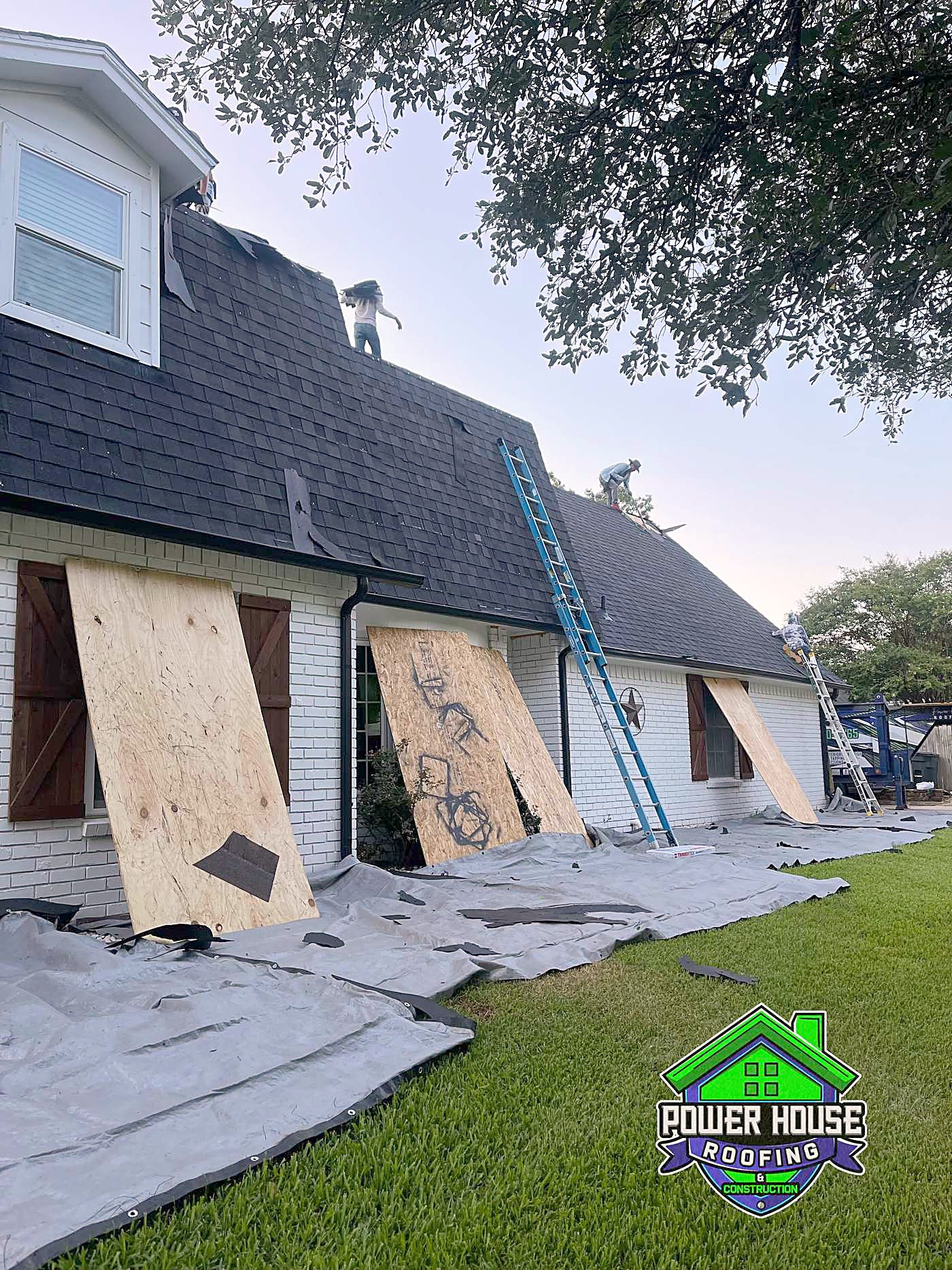
If hail has come through and you are not sure what it did, get the roof looked at while the storm date is recent. Power House offers free roof inspections to check for damage and whether it is storm-related, so you can file a timely claim. If the storm has already opened the roof, emergency tarping is available 24/7 to keep water out until the repair can start.
Related questions
Do I need three estimates for a hail damage claim?
No. You are not required to get three estimates, and you can choose whichever contractor you want to do the work on your property.
Will insurance replace the whole roof or only the damaged slopes?
It depends on how far the damage spreads. Adjusters approve individual slopes where hail damage is limited and a full replacement where it runs across the roof. If a partial repair would leave shingles that cannot be matched or tied in, raise it with the adjuster before the scope is settled.
Can an impact-resistant roof lower my premium?
It can. Texas insurers may discount premiums for roofing that passes the UL 2218 impact test, with Class 4 earning the most, and each company sets its own discount. Insurers commonly ask for Texas Department of Insurance form PC068 from the installer, and you have to ask for the discount yourself.
